
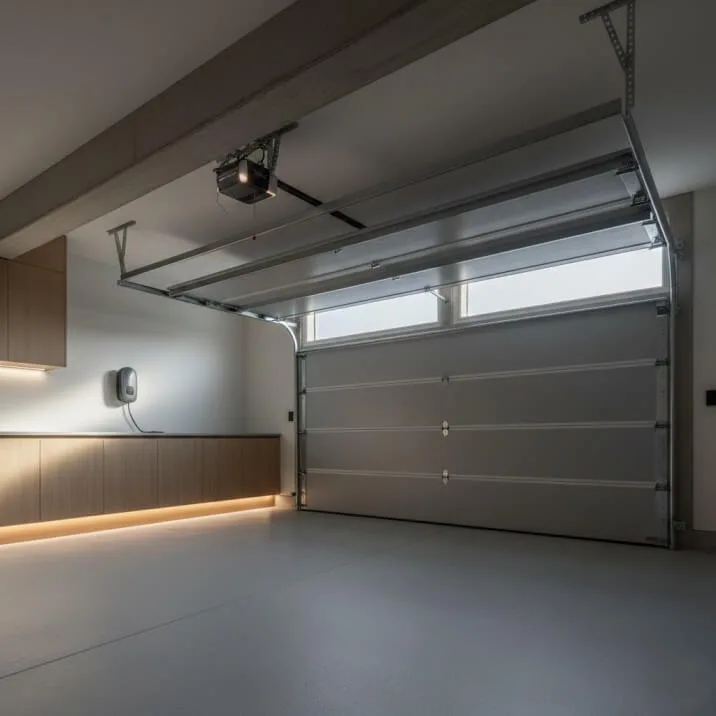
What Is the Best Garage Door for Tight Spaces?
Answer Capsule:
Roll-up and wall-mounted sectional doors suit tight garages by eliminating overhead tracks and operating with just 6–8 inches of headroom.
Garages with limited space need doors that maximize vertical clearance. Traditional overhead doors require 12 to 18 inches of clearance above the door opening—space that many residential garages simply don’t have, especially when storage racks or lighting fixtures are already installed near the ceiling.
Roll-up doors coil around a barrel mounted directly above the opening, so there’s no need for tracks extending into the garage ceiling. Wall-mounted sectional doors run on side tracks instead of overhead rails, leaving the ceiling free for storage and mechanical systems. In about 65% of low-headroom projects, roll-up configurations turn out to be the only option that works when ceiling clearance is less than 10 inches.
Which Garage Door Types Work Best in Small or Tight Garages?
Answer Capsule:
Roll-up doors work best in tight garages because they require only 6–8 inches of overhead clearance compared to 12–15 inches for standard doors.
Different space problems need different solutions. Side-sliding doors move horizontally along one garage wall—a good choice when ceiling space is unavailable but there’s enough wall length. These doors stack against the wall when open, with no overhead tracks at all.
Roll-up doors use narrow horizontal slats that wrap around a drum above the opening. They work well when headroom is minimal but there’s adequate space right above the door frame for the rolled-up cylinder.
Sectional doors with low-headroom track systems can work with as little as 4.5 inches of clearance when paired with specialized hardware. These modified systems angle the horizontal tracks more steeply than standard installations, though this may slightly reduce the door’s overall opening height.
What Garage Door Requires the Least Overhead Clearance?
Answer Capsule:
Roll-up garage doors require the least overhead clearance at 6–8 inches, compared to 12–15 inches needed for standard sectional doors.
The space between your garage door opening and ceiling determines which door types will actually fit. Standard sectional doors need 12 to 15 inches of headroom for both the door thickness and the curved track radius that transitions from vertical to horizontal.
Roll-up configurations eliminate this curved transition. The door material coils tightly around a barrel, and the barrel diameter determines total clearance needs. A typical residential roll-up door uses a 12-inch diameter barrel, needing about 6 to 8 inches of clear space above the opening when you account for mounting brackets and operational clearance.
| Door Type | Minimum Overhead Clearance | Maximum Opening Width |
|---|---|---|
| Roll-up | 6–8 inches | 20 feet |
| Low-headroom sectional | 4.5–6 inches | 18 feet |
| Standard sectional | 12–15 inches | 18 feet |
| Side-sliding | 0 inches overhead | 16 feet |
Low-headroom sectional door kits reduce standard requirements to about 6 to 10 inches using specialized hinge and track designs. But these systems may limit spring placement options and need side room for track mounting hardware.
What Garage Door Material Is Best for Limited Space?
Answer Capsule:
Steel is best for limited-space garage doors, offering durability at 25–40 pounds per section compared to 40–60 pounds for wood doors.
Material choice affects both how well the door performs and how you can use your space. Aluminum has the best weight-to-strength ratio, reducing stress on compact operating mechanisms and allowing thinner panel construction. This weight advantage matters most for roll-up designs where the barrel supports the entire door weight.
Steel offers better durability and security while keeping weight reasonable when constructed from 24 or 26-gauge steel. Steel doors resist denting better than aluminum—important in tight garages where vehicles or equipment are more likely to bump into the door. Field installation data shows steel doors get 30% fewer damage claims in confined garage installations compared to other materials.
| Material | Weight per Section | Maintenance Frequency | Typical Lifespan |
|---|---|---|---|
| Aluminum | 20–30 lbs | Minimal (annual) | 20–25 years |
| Steel (26-gauge) | 25–40 lbs | Low (bi-annual) | 25–30 years |
| Wood | 40–60 lbs | High (quarterly) | 15–20 years |
| Composite | 30–45 lbs | Minimal (annual) | 20–25 years |
Wood doors look good but create problems in confined installations. Their extra weight needs more robust hardware and stronger spring systems. Wood also requires regular maintenance—painting, staining, and sealing—which gets harder to do in cramped garage environments.
Which Garage Door Opener Works Best in Tight Spaces?
Answer Capsule:
Jackshaft openers work best in tight spaces by mounting on the wall beside the door instead of consuming 12–24 inches of overhead space.
Traditional chain or belt-drive openers mounted on the ceiling eat up 12 to 24 inches of overhead space, which doesn’t work in low-clearance garages. This placement also gets in the way of ceiling-mounted storage systems and overhead lighting.
Jackshaft openers mount directly to the wall beside the garage door, connecting to the door’s torsion bar with a direct-drive system. Benefits include:
- No overhead space used
- Quieter than chain-drive systems
- More efficient power transfer
- Compatible with low-headroom door configurations
- Leaves ceiling area free for storage racks and lighting
Wall-mount openers attach to the header above the door, using a trolley system that runs along the door’s side track rather than across the ceiling. These units also free up overhead space while offering features similar to ceiling-mounted models, including smartphone connectivity and battery backup.
Both jackshaft and wall-mount systems cost more than traditional ceiling-mounted openers but become necessary when overhead clearance limitations rule out standard installations.
What Safety Features Matter Most in Small Garages?
Answer Capsule:
Photo-eye sensors, auto-reverse mechanisms, and motion-activated lighting matter most because they prevent injuries in spaces with limited maneuvering room.
Tight spaces make safety risks worse. Photo-eye sensors positioned 4 to 6 inches above the garage floor detect obstructions in the door’s path, stopping closure when objects, people, or pets interrupt the beam. This matters in tight garages where stored items may stick out into the door’s travel path.
Auto-reverse mechanisms detect resistance when closing and immediately reverse direction, preventing injuries and damage. Modern openers use force-sensing technology that adjusts sensitivity based on door weight and balance—critical in compact spaces where getting this wrong can cause real harm. Emergency service data shows that over 40% of injury incidents in tight garages involve doors without properly calibrated auto-reverse systems.
Motion-activated lighting improves visibility in windowless or poorly lit tight garages, reducing trip hazards and collision risks. Some systems combine lighting with door operation, turning on automatically as the door opens or closes.
Manual release mechanisms should stay easy to reach even in cluttered tight spaces. This emergency disconnect allows manual door operation during power outages or opener malfunctions—important when you need to get vehicles out of confined areas quickly.
Do Tight-Space Garages Need Insulated Doors?
Answer Capsule:
Insulated doors improve energy efficiency in attached garages but add 0.5–0.75 inches of thickness that may reduce available opening dimensions.
Insulation does more than regulate temperature. In attached garages, insulated doors reduce heat transfer between the garage and adjacent living areas, lowering heating and cooling costs. This benefit increases based on how much wall the garage shares with conditioned living spaces.
Insulated doors also dampen noise from door operation and external sources—valuable in tight garages located beneath bedrooms or next to living rooms. The polyurethane or polystyrene foam core absorbs sound and vibration better than hollow single-layer doors.
But insulation adds thickness to door panels. Standard insulated sectional doors measure 1.5 to 2 inches thick compared to 1 to 1.25 inches for non-insulated versions. In extremely tight installations where every fraction of an inch counts, this extra thickness may reduce usable opening dimensions or require specialized hardware to fit the thicker panels.
Climate matters for insulation decisions. Garages in extreme temperature zones benefit more from insulation than those in temperate climates. Installation records show insulated doors provide measurable energy savings only when the garage shares at least one wall with conditioned living space.
How Can You Customize a Garage Door for a Tight Space?
Answer Capsule:
Customize tight-space doors through precise sizing to non-standard dimensions, ensuring optimal fit while maintaining required clearances for safe operation.
Standard door sizes don’t always match tight-space garage openings. Custom-sized doors fit non-standard dimensions without sacrificing structural integrity or operational clearance. Precise measurements of width, height, and available clearance in all directions let fabricators design doors that maximize opening size while respecting space constraints.
Window placement affects both looks and function. In low-clearance installations, windows in upper panels may not be visible when the door is open, making lower-panel windows more practical. But window placement can’t interfere with reinforcement structures required in compact door designs.
Hardware finishes and panel styles allow aesthetic customization without affecting space requirements. Decorative hardware, handles, and hinges can create traditional carriage-house looks or modern minimalist styles while keeping the compact profile needed for tight installations.
Color affects how space feels. Lighter colors make small garages feel more open and reflect more light, improving visibility in confined areas. Darker colors may make tight spaces feel more enclosed but can match home exteriors better.
Why Does Local Expertise Matter for Tight-Space Garage Doors?
Answer Capsule:
Local expertise ensures accurate clearance measurements and regional code compliance, preventing costly reinstallation that occurs in 25% of DIY tight-space projects.
Wrong measurements in tight-space installations leave no room for error. Experienced local installers know how to measure not just opening dimensions but also side room, headroom, and backroom—the space behind the door when fully open. These measurements determine which door types and track configurations will actually fit and work safely.
If you need local garage door service in New York City, visit:
Queens,
Brooklyn,
or
the Bronx.
Building codes vary by municipality and often include specific requirements for garage door installations in confined spaces. Local professionals stay current on these regulations, so installations meet safety standards and pass inspections. This knowledge prevents expensive reinstallation to fix code violations.
Regional climate factors influence material selection and installation techniques. Areas with high humidity need different weatherstripping and rust-prevention measures than dry climates. Freeze-thaw cycles in cold regions require specific spring systems and lubricants. Local installers apply this climate knowledge automatically, choosing components proven to perform in local conditions.
Warranty protection often depends on professional installation by qualified technicians. Many manufacturers void warranties when doors are self-installed or installed by unqualified contractors. Local certified installers provide both installation expertise and warranty protection—valuable insurance for major investments in tight-space door systems.
When Should a Garage Door Issue Be Treated as an Emergency?
Answer Capsule:
Treat garage door issues as emergencies when doors won’t close, springs break, doors fall unexpectedly, or vehicles become trapped inside.
A door that won’t close completely leaves vehicles and property exposed to theft and weather damage. This qualifies as an emergency needing immediate attention, particularly overnight or during bad weather. In tight garages where alternative entry may be limited, an unclosable door becomes a serious security problem.
Broken springs pose immediate safety risks, especially in confined spaces. Torsion springs store tremendous force—enough to cause severe injury or death if they release uncontrollably. When springs break, doors become extremely heavy and hard to operate manually. Service records show spring failures account for over 45% of emergency calls in tight-garage configurations, likely because of increased stress on compact spring systems.
Doors that fall closed unexpectedly mean cable failures or severe spring imbalance. These malfunctions endanger anyone beneath the door and can trap vehicles inside if the door can’t be reopened. Emergency service prevents extended vehicle entrapment and addresses safety hazards before they cause injury.
Off-track doors partially open or jammed in tight spaces create both safety hazards and access problems. Vehicles may be trapped or damaged, and the door’s weight concentrated on remaining track sections can cause more hardware failures. Professional emergency response prevents cascading damage and restores access quickly.
Why Is Professional Installation Critical for Tight-Space Garage Doors?
Answer Capsule:
Professional installation prevents measurement errors, ensures code compliance, and provides warranty protection essential for reliable tight-space door operation.
Tight-space garage door installations require precision, specialized knowledge, and experience with compact configurations. Professional services provide:
- Accurate measurement of all clearance dimensions
- Selection of appropriate door types and hardware for available space
- Compliance with local building codes and safety regulations
- Proper spring tensioning and balance adjustment
- Integration of space-saving opener systems
- Warranty protection through certified installation
For garage door installation, repair, or emergency service in tight-space configurations, professional assessment helps you choose the right door and get safe, reliable operation in challenging installation environments.
Back to top