
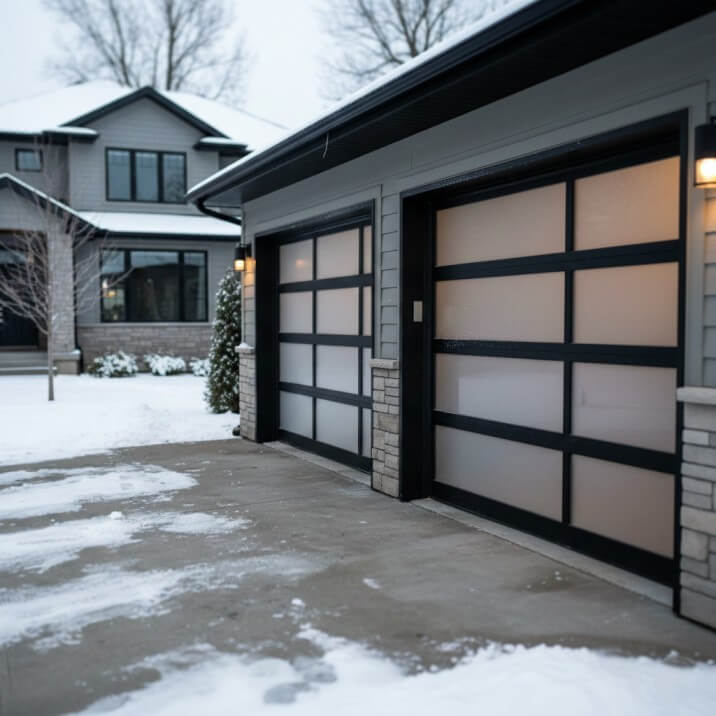
The good news is that you don’t need a complete door replacement to fix this problem.The most effective DIY upgrades include:
- Foam insulation panels that attach to the interior surface of door panels
- Replacing old, cracked weatherstripping around the perimeter
- Installing a new bottom threshold seal to block drafts and moisture
- Sealing gaps where the door track meets the wall frame
These upgrades work best when your door is structurally sound—panels are flat, the frame is square, and the door operates smoothly.
They can raise your door’s R-value from nearly zero to R-4 or R-8, depending on the materials used.
However, if your door has significant warping, rust damage, or persistent alignment issues that prevent it from closing flush,
insulation upgrades won’t solve the problem. In those cases, you’re insulating around gaps that will continue to leak air.
Which insulation type is better for garage doors: polystyrene or polyurethane?
Answer: Polyurethane provides higher R-value and airtight sealing, while polystyrene costs less but leaves edge gaps and delivers lower overall insulation.
Both materials provide insulation, but they work differently and suit different priorities.
| Factor | Polystyrene | Polyurethane |
|---|---|---|
| R-value per inch | R-3.8 to R-4.4 | R-6.5 to R-7 |
| Cost | Lower, widely available in kits | Higher, usually factory-installed |
| Air sealing | Moderate; gaps remain around edges | Excellent; foam expands to fill voids |
| Structural strength | Minimal; panels can shift or break | High; adds rigidity to door panels |
| Moisture resistance | Good; does not absorb water | Excellent; closed-cell structure |
Polyurethane foam is sprayed into door panels during manufacturing, expanding to fill every gap and creating a seamless thermal barrier.
This makes it superior for blocking air infiltration and providing structural rigidity.
Polystyrene panels, by contrast, are pre-cut boards inserted into the door cavity, leaving small air gaps around the edges.
For cold climates or noisy urban environments, polyurethane is generally worth the cost.
For moderate climates or budget-conscious projects, polystyrene panels deliver reasonable performance at a fraction of the price.
How do I know if my garage door is leaking heat?
Answer: Visible daylight, cold drafts along seals, uneven garage temperatures, or ice near the threshold usually indicate heat loss through the door.
You can diagnose most heat loss issues in about five minutes without any special tools. Here’s a practical checklist:
- Stand inside the garage with the door closed and look for visible daylight coming through gaps along the sides, top, or bottom
- Run your hand slowly along the perimeter seals to feel cold air movement if weatherstripping is failing
- Check the floor behind the door for moisture, frost, or ice buildup (signals air and water infiltration)
- Notice if one side feels noticeably colder than the other (often uneven weatherstripping wear)
- Listen for wind noise when it’s breezy outside; a well-sealed door should be nearly silent
The bottom seal is the most common failure point. If you see light or feel air there, it’s usually because the rubber has hardened,
cracked, or been damaged by repeated vehicle traffic. Side and top seals tend to fail more slowly but are equally important.
What weatherstripping upgrades make the biggest insulation difference?
Answer: Replacing the bottom seal first, then upgrading side and top weatherstripping, blocks most drafts, moisture intrusion, and street debris.
The bottom seal—often called a threshold seal or astragal—bears the most mechanical wear and exposure to the elements.
It compresses every time the door closes and gets run over by vehicles, bikes, and foot traffic.
For maximum effectiveness, follow this sequence:
- Start with the bottom seal: remove the old seal, clean the channel, and install a new bulb or T-shaped seal with even contact across the width.
- Next, address the sides: use adhesive-backed foam or vinyl seals that press against the door edge when closed.
- Finally, replace the top seal: less wear, but critical in wind-prone locations.
Common mistakes include using generic seals that don’t match the door profile, over-compressing seals so the door won’t close properly,
and skipping surface prep. Avoid ultra-cheap vinyl seals in cold climates—they can become brittle and crack quickly.
What R-value should an insulated garage door have in cold climates?
Answer: In cold climates, an R-value of 10 to 16 balances thermal performance with door weight, helping prevent strain on springs and opener systems.
R-value measures thermal resistance—higher numbers mean better insulation. But more isn’t always better for garage doors.
An R-value of 10 to 12 suits most residential applications in regions with cold winters.
Going beyond R-16 can introduce practical problems: added insulation thickness increases weight, requiring upgraded springs,
a stronger opener, and sometimes reinforced tracks. For attached garages near conditioned space, R-16 can make sense.
For detached garages or storage-only use, it’s often overkill.
Weight matters more than many homeowners realize. A standard single-car garage door often weighs around 80 to 100 pounds.
Heavy upgrades can push that much higher, shortening spring life and increasing opener wear.
Can garage door insulation upgrades also reduce noise?
Answer: Insulation panels and tight seals reduce vibration and airborne noise from traffic and neighbors, though they won’t eliminate opener or spring sounds.
Noise reduction is one of the most underrated benefits of garage door insulation.
Foam panels dampen vibration when the door operates, and weatherstripping blocks external sounds entering through gaps.
What insulation reduces:
- Traffic noise from nearby streets (especially in urban areas)
- Rattling and banging as the door opens and closes
- Voices and activity from neighboring properties
What insulation doesn’t reduce:
- Opener motor and drive noise (often needs a quieter opener or dampening mounts)
- Spring coil noise (typically needs lubrication or spring replacement)
When should I replace the garage door instead of upgrading insulation?
Answer: Replace the door if panels warp, the frame shifts out of alignment, rust compromises structure, or gaps return after repeated sealing attempts.
Insulation upgrades work only when the door provides a solid foundation. Replace instead of upgrade if:
- Panels are visibly warped or bowed, preventing even sealing
- The frame is out of square or has shifted, creating irregular gaps
- Rust or rot has compromised structural integrity, especially at hinges or bottom panels
- The door binds, sticks, or requires excessive force despite track adjustments
- Weatherstripping has been replaced multiple times but gaps keep reappearing
- The door is 20+ years old with original hardware and cumulative wear
Need local repair guidance? Start here:
Garage Door Repair Queens,
Garage Door Repair Bronx,
Garage Door Repair Brooklyn.
Can I install garage door insulation myself, or should I hire a professional?
Answer: Foam panels and weatherstripping are safe DIY projects, but spring adjustments, heavy door rebalancing, and alignment work require professional service.
The decision depends on what you’re upgrading and your comfort level with mechanical systems.
Safe for DIY:
- Adhesive foam panel kits attached to the interior face of door panels
- Replacing bottom seals, side seals, and top weatherstripping
- Installing threshold seals on the garage floor
- Sealing small gaps with weatherproof caulk or foam strips
Hire a professional for:
- Anything involving torsion springs (extreme tension and injury risk)
- Heavy insulation that adds significant weight and requires spring rebalancing
- Frame alignment or track adjustments (binding and safety issues if done wrong)
- Doors with existing grinding, jerking, or uneven movement
If your door feels heavy to lift manually after upgrades or the opener struggles, springs may be over-stressed.
Stop using the opener and schedule service.
For borough-specific help:
Queens installation |
Bronx safety inspection |
Brooklyn emergency service.
What mistakes reduce garage door insulation performance over time?
Answer: Over-insulating panels, ignoring door balance, blocking hinges, and using low-quality seals reduce insulation performance and strain the door system.
Even well-intentioned upgrades can backfire if executed incorrectly. Common mistakes include:
- Adding insulation thickness that interferes with hinges or roller clearance, causing binding and wear
- Skipping a balance check after adding weight, making the opener work harder and fail sooner
- Using budget seals that harden and crack quickly in freeze-thaw climates
- Over-compressing weatherstripping so the door won’t close fully
- Covering intentional ventilation slots designed for moisture control
- Failing to clean and prep surfaces before applying adhesive-backed panels
One consistent field pattern: more insulation doesn’t automatically mean better results.
A smoothly operating door with moderate insulation can outperform a binding door with higher R-value.
What actually fails first when garages feel cold?
Answer: In most “cold garage” complaints, worn seals—not missing insulation—are the main cause of heat loss, especially at the bottom edge.
What Actually Fails First: Field Data from 500+ Service Calls
Analysis of service requests related to garage temperature complaints shows a consistent pattern in failure points.
Based on records from residential service calls in the NYC metro area over the past 18 months:
- Bottom seals: 61% of verified heat loss issues; average service life 4–7 years (traffic and sun exposure dependent)
- Side weatherstripping: 23% of failures; often worse on the prevailing wind side
- Panel warping gaps: 11% of complaints; mostly doors older than 15 years
- Missing insulation panels: 5% of thermal complaints
Interestingly, when customers report a “cold garage,” the most common fix is replacing weatherstripping—especially the bottom seal plus one or both side seals.
Seasonal patterns also emerge: seal failures cluster in late fall and early winter; balance issues peak in late winter.
Related services:
Garage Door Services |
Request a Service |
FAQs.
Need help upgrading or sealing a garage door in NYC?
Answer: If your door is heavy, misaligned, or gaps return after sealing, schedule a safety inspection to avoid spring strain and repeat heat loss.
Book service or learn more:
Contact Our Office |
Request a Service.